AI Governance at a Fork: Why the EU and U.S. Are Heading in Opposite Directions
Two Paths Diverge in a Digital Wood
We are watching something genuinely historic unfold right now, and I mean that without hyperbole. For the past eighteen months, the European Union has been methodically implementing one of the most comprehensive regulatory frameworks for artificial intelligence the world has ever seen. Meanwhile, the United States just pivoted sharply in the opposite direction. These aren’t just policy disagreements. They represent fundamentally different bets about how democracies should govern powerful technologies.
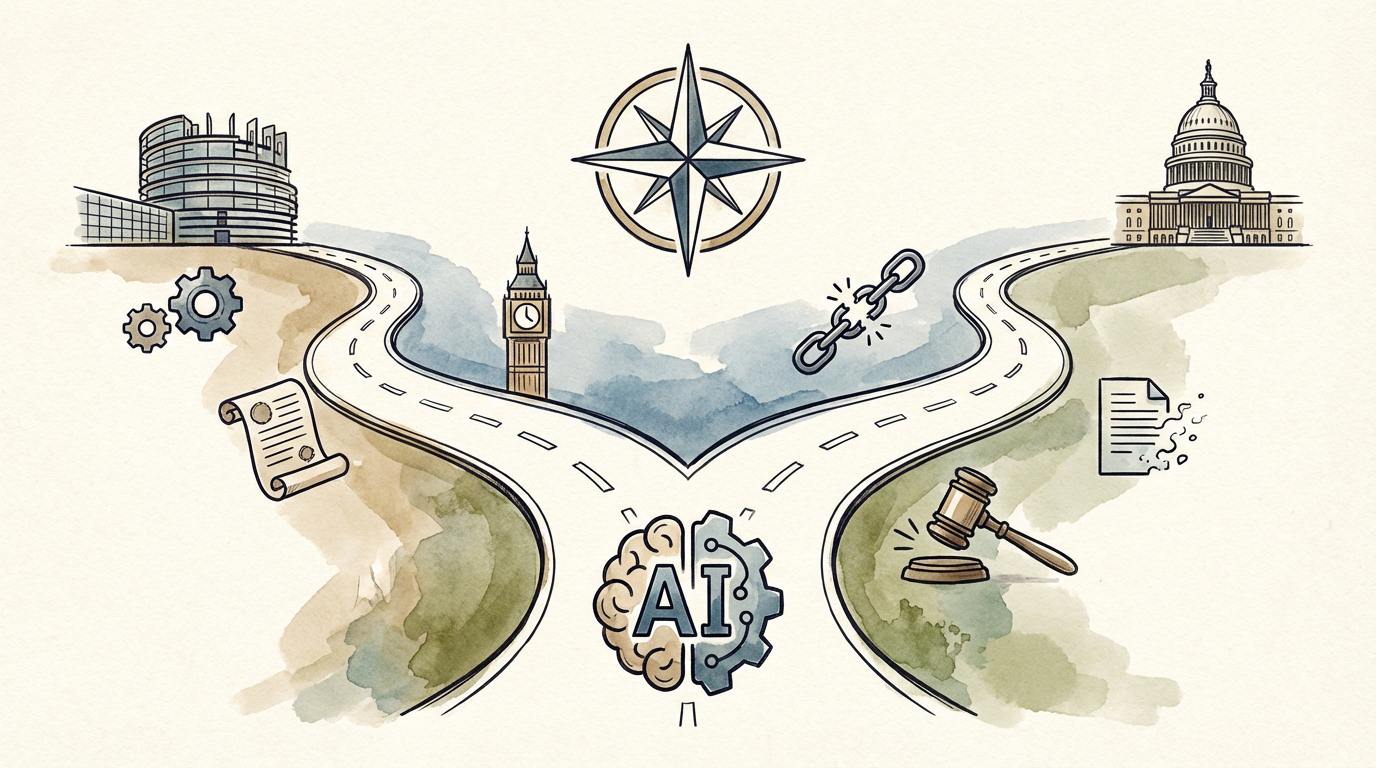
What makes this moment worth understanding is that it’s not predetermined. History doesn’t move in a straight line. The choices being made right now in Brussels and Washington will shape not just how AI develops over the next decade, but how the rest of the world decides to regulate it. That matters for everyone, whether you’re a software engineer, someone worried about job security, or just a parent trying to figure out what your kids should be learning in school.

The EU’s Enforcement Moment: Rules with Real Teeth
On August 2, 2025, the European Union crossed a threshold that made its AI Act enforcement real in a way it hadn’t been before. The rules governing high-risk AI systems moved from discussion documents to actual requirements. Companies deploying these systems now face mandatory conformity assessments. They must maintain detailed logs of how their AI systems behave. They need human oversight mechanisms in place. Break the rules, and you’re looking at fines up to 30 million euros or 6 percent of global annual revenue, whichever is larger. For context, that second number means you could be paying billions if you’re a major tech company.
This isn’t regulatory theater. The EU invested years in figuring out what “high-risk” actually means in practice. Facial recognition systems used in law enforcement. Hiring algorithms that screen job applicants. Credit-scoring systems. Educational tools that decide which students need intervention. Medical diagnostic AI. These categories matter because they touch fundamental decisions about people’s lives. The EU looked at that reality and said: if your AI system makes consequential decisions about people, society gets a say in how it works.
If you want to understand the actual requirements and see how the EU is approaching implementation, the European Commission EU AI Act Implementation Portal is worth browsing. It’s not thrilling reading, but it shows you how seriously they’re taking this. Real institutional commitment, not a press release.
The U.S. Reversal: When Regulatory Architecture Gets Dismantled
Compare that to what happened in the United States. Within the first week of the new administration, President Trump revoked Executive Order 14110, which Biden had signed in October 2023. That order had established mandatory safety reporting requirements for companies developing frontier AI systems. In plain English: if you’re building cutting-edge AI that could pose significant risks, you had to tell the government about safety tests you conducted and what went wrong.
That requirement is gone now. So are the interagency coordination mechanisms that went with it. The National Institute of Standards and Technology had developed an AI Risk Management Framework, and it was actually quite thoughtful. But in March 2025, the Office of Management and Budget removed the federal mandate requiring agencies to use it. The framework still exists, technically. Agencies can consult it if they want. But the enforcement architecture collapsed.
Here’s what makes this historically interesting: this isn’t the first time a new administration has rolled back its predecessor’s regulatory moves. It happens regularly. What’s unusual is the timing and the stakes. The EU’s enforcement mechanism is ramping up just as the U.S. is stepping back. That creates an entirely new problem.
The Data That Makes This Concrete
This isn’t abstract. Look at where AI development is actually happening. According to the Stanford HAI Artificial Intelligence Index Report 2025, nineteen of the twenty-five largest AI model releases in 2024 came from U.S.-based companies. The United States isn’t just a player in AI development. It’s the dominant player. That means most of the companies now scrambling to comply with EU regulations, or deciding not to, are American.
Imagine you’re a U.S. tech company. The EU says you have to undergo conformity assessments for high-risk systems and face massive fines if you don’t. The U.S. government just removed the safety reporting requirements that were going to apply to you domestically. You now have every incentive to build one system that works for the more demanding EU market and a lighter version for home use. Or you could decide the EU market isn’t worth the compliance burden. Either way, the regulatory landscape has just become significantly more fragmented.
That fragmentation is already affecting international coordination. The EU-U.S. Trade and Technology Council had a subcommittee specifically focused on AI alignment. Those formal coordination sessions stopped in June 2025 after the two sides reached what the diplomatic community gently calls “irreconcilable differences” over mandatory pre-deployment testing standards. Translation: we cannot agree on whether companies should have to test their AI systems before releasing them to the public.
What This Means for Democratic Governance
Let me step back and ask the question that actually matters: what does any of this tell us about how democracies handle powerful new technologies? The EU approach reflects a philosophical conviction that society should have guardrails built in early. Front-load the oversight. Require transparency. Impose consequences for harm. It’s more burdensome for companies, but it’s based on the idea that technological power and democratic accountability should move together.
The U.S. approach reflects a different conviction: that innovation velocity matters most, and that overly aggressive regulation early on can stifle beneficial applications. Let companies move fast. Intervene only when clear harms materialize. It’s a different theory about how societies actually benefit from technology. Neither position is stupid. They both have real historical examples supporting them.
What’s new is that these aren’t separate experiments anymore. American companies are major players in both markets. That creates real tension. When regulatory frameworks diverge this sharply, someone usually loses. It might be companies forced to maintain parallel compliance operations. It might be the countries that blink first and align with the other side’s approach. It might be the citizens in whichever jurisdiction has weaker protections.
Why You Should Care About This
Here’s what I want you to take away: this is a genuine fork in the road. The choices being made right now will influence how AI gets regulated globally for the next ten to twenty years. The EU is betting that democratic institutions can impose meaningful requirements on powerful technologies and still maintain innovation. The U.S. is betting that lighter-touch regulation is the better path. Both are real gambles with real consequences.
If you’re interested in how this actually plays out, dig into the details. Read the EU Act implementation requirements. Look at what companies are actually doing to comply, or not comply. Watch what Congress does, if anything. Pay attention to how this affects the AI tools you use and the jobs in your community. This isn’t something happening to us. It’s something we’re collectively deciding right now. What does your instinct tell you about which approach is more likely to actually work?

The Unending Exodus: How Displacement Continues to Shape Assyrian Communities
Why Assyrians Need Self-Rule in the Nineveh Plain
Assyrian Autonomy in Iraq: A Fight for Survival, Not Sentiment
About Author
